
How Payload Capacity Affects Your Articulated Hauler’s Long-Term ROI
Key Takeaways:
Payload capacity is one of the most consequential spec decisions when purchasing an articulated hauler. Consistently overloading a hauler accelerates wear on drivetrain, suspension and tire components, increases fuel consumption and shortens the machine’s service life, all of which erode long-term ROI. Underloading creates a different problem: your cost per ton of material moved increases because you’re paying to purchase and maintain a machine with more capacity than your operation regularly demands. Matching payload capacity to your actual job site conditions and material weights, while accounting for underfoot conditions, grade and how your workload may change over time, is the most reliable way to protect your investment and get the most out of your machine.
Payload capacity is one of the most important factors to evaluate when purchasing an articulated hauler for your fleet. This spec, which tells you the maximum amount of weight your hauler can safely carry, determines how much material you can move per cycle, how hard your hauler will have to work and what your maintenance needs will be. When you choose an articulated hauler with the right payload capacity for your applications, it will improve your productivity while minimizing the wear and tear on your machine’s components.
Understanding the Relationship Between Payload Capacity and Equipment ROI
The rated payload capacity of an articulated hauler impacts nearly every aspect of how the machine performs and how much it costs to operate over its lifetime. As a result, the relationship between payload and ROI goes beyond determining whether the machine can physically carry the load. It also helps you understand whether the machine is being used in a way that keeps operating costs predictable, wear rates manageable and productivity at the level your operation requires.
You’ll receive your best ROI on your articulated hauler when the site, material and loading system are matched to your hauler’s payload capacity. When these factors align, each trip carries the maximum amount of material while reducing the haul-cycle cost per ton.
Overloading Accelerates Wear and Drives Up Operating Costs
Exceeding an articulated hauler’s rated payload capacity is one of the fastest ways to shorten its service life. The effects can accumulate quickly when overloading becomes a routine part of your operations.
Drivetrain and Component Wear
Articulated haulers are engineered to handle specific load ranges. When a machine is routinely loaded beyond its rated capacity, the stress placed on drivetrain components, axles, suspension systems and tires increases substantially. Wear accumulates faster than it would under normal operating conditions, which translates into:
- More frequent repairs
- Shorter intervals between major maintenance events
- Components that need replacing well before the end of their expected service life
On a machine you’re planning to run for 10 or more years, that accelerated wear schedule has a significant impact on total cost of ownership.
Fuel Consumption
An overloaded hauler works harder to move the same distance. The engine and drivetrain are under greater strain, which increases fuel consumption per cycle. On job sites where haulers are running continuously throughout the day, even a modest increase in fuel burn per load adds up to a significant cost difference over the course of a project.
Job Site Safety
Overloading also creates safety risks that go beyond equipment wear. Handling characteristics change when a hauler is carrying more than it’s designed for, particularly on grades, in soft underfoot conditions or when maneuvering in confined areas. Braking distances increase and stability decreases, raising the risk of an accident on the job site.
Underloading Creates Efficiency and Cost Issues
Underloading doesn’t damage a machine the way overloading does, but it can negatively impact your productivity and overall costs.
When your hauler’s rated capacity significantly exceeds the loads you’re actually moving, your cost per ton of material moved increases. You’re burning fuel, accumulating hours and paying operator time on a machine that isn’t being utilized to its potential. Over a long project, that inefficiency can significantly impacts your bottom line.
There’s also the upfront cost to consider. Larger machines cost more to purchase and more to maintain, and those costs don’t decrease because the machine isn’t being fully utilized. If your operation doesn’t regularly demand that extra capacity, you’re spending more on equipment than the work justifies.
Payload Capacity Has to Account for Real Job Site Conditions
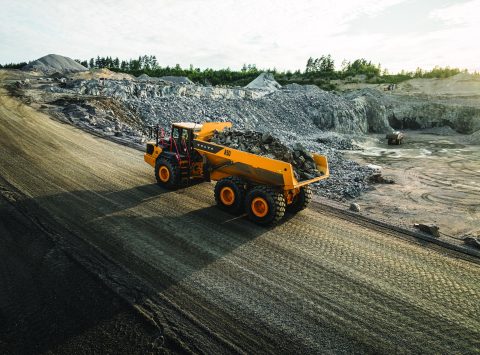 Understanding your actual operating conditions will help ensure you select the right payload capacity for your articulated hauler.
Material Weight Varies More Than You Might Expect
The rated payload of an articulated hauler is a weight-based spec, not a volume-based one. Different materials have significantly different densities, and a hauler that’s appropriately loaded with sand may be overloaded carrying the same bucket volume of wet clay or rock. Knowing the actual weight of the materials you’re handling is essential to determining whether a machine is being loaded correctly.
Underfoot Conditions and Grade Affect How Hard the Machine Works
Soft, muddy or uneven terrain increases the strain on drivetrain and suspension components even when the hauler is carrying a nominal load. As a result, job sites with consistently poor underfoot conditions call for more conservative loading practices. Similarly, steeper grades and longer haul distances put more sustained stress on the drivetrain and braking systems. Both of these factors should inform the payload capacity you select and the loading practices you establish on site.
Factor in How Your Operation May Change Over Time
An articulated hauler purchased today should be evaluated not just against your current operation, but against the type of work you’re likely to be doing in three to five years.
If your projects are trending toward larger-scale earthmoving or heavier material, a machine that’s well-matched today may no longer have enough capacity sooner than expected. If you anticipate more varied or smaller-scale work, a machine with more capacity than you typically need may not be the best use of your budget. The difference in cost between two payload classes is often modest compared to the cost of replacing a machine ahead of schedule, so it’s worth factoring your anticipated workload into the decision before you buy.
Payload Management Doesn’t Stop at the Point of Purchase
Selecting the right payload capacity is the starting point. How the machine is loaded in day-to-day operations has just as much impact on long-term ROI.
Establishing clear loading targets for your operators, using on-board payload monitoring systems where available and periodically reviewing load data against manufacturer recommendations are all practical steps to protect your investment. Many modern articulated haulers offer integrated payload monitoring that gives your operators and fleet managers real-time visibility into load weights, making it significantly easier to keep loads consistent across a job site.
McClung-Logan Can Help
If you’re considering upgrading your articulated hauler fleet, McClung-Logan can help ensure you choose the right machine for your specific needs. Our team will discuss your usage with you in detail to understand the payload capacity necessary to maximize your long-term ROI, and we’ll make customized equipment recommendations that align with your applications.
We’ve been the leading heavy equipment dealer in the Mid-Atlantic region since 1939. During this time, we’ve developed a reputation for providing quality equipment at a reasonable price, backed with the customer service you need to get the most out of your investment. We offer an extensive line of new and used articulated haulers for sale, as well as a large fleet of rental equipment, ensuring you’ll find the right machine for your needs.
As your dedicated heavy equipment partner, we’re committed to your ongoing success and we back this up by providing:
- 24/7 assistance
- A highly trained service team
- Extensive inventory on hand to ensure you receive any parts as quickly as possible
- Communication in your preferred method (phone, text, email)
- Loaner equipment, whenever possible, to minimize downtime while your equipment is being serviced
Contact one of our branch locations to speak with a Territory Manager. McClung-Logan is a full-service heavy equipment dealer serving the Mid-Atlantic region.